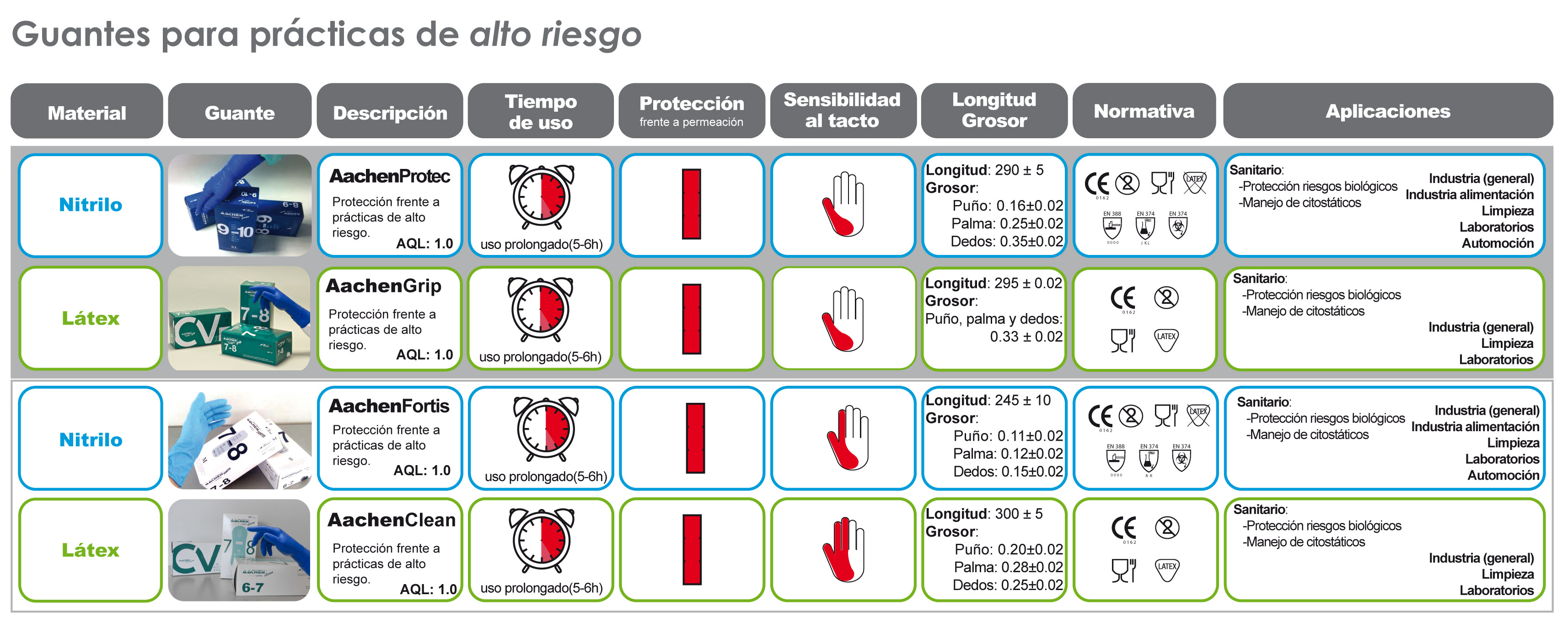
This table shows the differences between the 4 gloves of the “high risk” range. Besides the material, the fundamental difference is sensitivity to touch where the AachenClean highlights. Click on the image for full resolution.
As you might know, we have recently incorporated the nitrile glove AachenProtec to our range of gloves for high-risk practices, equivalent to the AachenGrip latex glove, to provide a nitrile/latex alternative within that range. Del mismo modo, no queríamos privar a nuestros usuarios del guante de nitrilo AachenFortis de un guante de similares características pero en látex, con las ventajas añadidas inherentes a este material: por ello nace el AachenClean.
Although both ranges (AachenGrip& AachenProtec VS AachenClean& AachenFortis) are classified in the category of gloves for high-risk practices, the AachenClean and AachenFortis have a lower thickness, giving the user greater sensitivity, without losing protection. More specifically, the latex glove AachenClean is almost 50% thicker than the nitrile AachenFortis but, as the latex material is the one that best mimics the characteristics of the skin, the user does not lose touch. Additionally, it is our second longest glove behind AachenPlus, with a length of 300 mm. In addition, one of our longest gloves, along with the AachenPlus, made of nitrile, with a length of 300 mm.
Due to its thickness and extra resistance, this glove, as you may have guessed because of its name, is primarily directed to the cleaning and hygiene sector, because it withstands most chemicals and it can be used for long periods of time. Compared to the usual reusable latex glove we can find on the market, the AachenClean provides a greater comfort, because the sizing and elasticity allows a perfect hand fitting.